

Follow the Money
Why money drives markets, and markets drive the economy.

Introduction
This week’s letter is on the shorter side, but that doesn’t diminish how important today’s topic is. This letter will unpack an outer layer of the onion when it comes to understanding the global monetary system. Why does this matter? Because your retirement (superannuation) is invested globally, capital has no borders, and what happens in the Middle East and so on, impacts your commercial assets or anything you own.
Having a clear and accurate understanding of how the world works is essential in determining how to allocate your finite resources, time, money, skills, etc.
Index
What you’re taught / told
Traditional view - which doesn’t match observable reality
Alternative view (based on reality)
Conclusion
Closing thoughts and updates
What you’re taught / told
Let’s start by assessing how mainstream academia, media and politicians talk about how our world works when it comes to the economy and finances.
The ‘logic’ (just because it’s logical doesn’t make it the truth) is that the economy is at the centre and everything flows out from it.
If the economy is strong, then this means unemployment is falling, company earnings are up (and therefore profit), the consumer spends more, and overall confidence improves, which is a good thing.
If the economy is weak, then unemployment rises, profits fall (which is not a good thing), spending slows, and confidence deteriorates.
The train of thought is that if the real economy is doing well, then financial markets will do well too, and so the businesses listed on public exchanges are like thermometers. If the real economy begins to suffer, so do the share prices of publicly traded businesses.
So, if you anticipated the economy to struggle, you wouldn’t buy shares in fear that it would be a bad time if the economy did turn around and ‘go down’ (contraction in GDP).
This leads investors to think:
Strong economy = Buy shares.
Weak economy = Avoid shares.
Recession = Markets fall.
Recovery = Markets rise.
In this framework, money itself is seen as a neutral tool used to facilitate trade, while banks are viewed as institutions that simply move existing savings from one person to another (financial intermediaries).
A healthy economy creates healthy markets. Mainstream Framework: Economy > Financial Markets
Traditional view - which doesn’t match observable reality
The traditional view on how the global economy works holds up in theory, but when applied to the real world, it’s unfortunately not what is happening. If you watch any news, you’ll know that consumer confidence, and consumer spending especially, post-Covid, never really recovered... Western economies have been on life support.
A great example of this is Germany, the third largest economy in the world. Germany’s GDP growth rate per year has been terrible... Since 2022, Germany’s economy has basically gone sideways. There’s been no economic prosperity or growth for anyone on a net basis.
Germany’s nominal GDP growth per year (for the last 5 years)
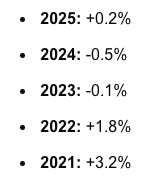
So, with the traditional view of how the economy works, this should mean the German share market performed terrible too.. With no economic growth, this should mean the businesses in Germany suffered, right?
Well, no, the German Stock Market Index (the DAX or known as DE40), which tracks the 40 largest blue-chip companies on the Frankfurt Stock Exchange, achieved an average annualised return of 10.20% p.a.
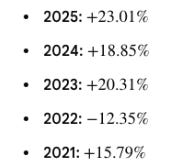
Source: Google (data available from World Bank etc)
I appreciate that the top 40 stocks don’t necessarily reflect the average publicly listed German stock, and possibly they have lots of international exports and don’t sell products into Germany, but not enough, in my opinion, to ‘not feel’ the rubbish economic growth.
So how do we reconcile this? Of course, the natural tendency is to ask questions and investigate further, that maybe the initial hypothesis created to explain how the economy and financial markets works isn’t quite correct.
Unfortunately, many ‘experts’ accept the status quo, call this an anomaly, blame the war with Ukraine impacting gas and energy markets and dragging down manufacturing, etc, you get the idea.
In the interest of your time, we won’t go through more examples, but you get the picture!
Alternative view (based on reality)
A more accurate lens and framework to see the global economy through at a high level is:
Money > markets > economies
I first heard this from Michael Howell, who now provides macro research to institutional investors (family offices, hedge funds, private wealth managers, etc.) but used to work as a bond trader for Salomon Brothers back in the ‘80s and ‘90s, who, at the time, were the largest bond traders in the world.
His thesis (which I agree with) is that instead of economies driving financial markets, it’s the other way around, that financial markets drive economies. So, the question then is what drives financial markets?
Well, we know most think it’s earnings, profitability and a positive economy, but in Mr Howell’s view, financial markets are driven primarily by money flows, which is downstream of liquidity.
The thought process behind the thesis is:
Part 1: Money
It all starts with ‘money’. The prices of money (being interest rates), but more importantly, the amount or quantity of ‘money’ in the system. Is this pool of money growing or contracting, where is the money coming from and for what purpose as well?
It’s also important to remember that in modern economies, most money is created when banks extend new credit (click here for my letter published on 18.11.2025 ‘The secret power of banks...’ for more context). Every new mortgage, business loan or government deficit financed through the banking system creates additional purchasing power (diluting the value of all existing money in the system).
This pool of available capital is what we call liquidity. Think of liquidity as the amount of financial fuel available in the global system.
Part 2: Markets
All money that is created anywhere in the globe needs to go somewhere. The thing is, the people who are closest to the ‘printing press’ and have access to the cheapest money typically don’t need more money.. These people have plenty to pay their bills, cover housing and food, etc... So what do they do with any ‘extra money’?
They BUY assets. Shares, land, real estate, commodities, infrastructure and so on. The newly created money generally does not immediately flow into the real economy. It often enters financial markets first.
Asset prices are therefore heavily influenced by the amount of liquidity available.
Part 3: Economies
How do the financial markets impact the real economy? Well, when asset prices are rising, such as higher house prices, this makes homeowners feel wealthier than they really are, and therefore, they’ll spend more as a result.
Higher share prices lower the cost of capital for businesses. Stronger investment portfolios encourage spending. Businesses find it easier to raise funds (larger businesses). Banks become more willing to lend to medium to large businesses. Confidence improves.
The economy often follows the direction established by financial conditions.
This is called the wealth effect, and it is very powerful.
The opposite can also occur, which can have devastating effects on the real economy if financial markets go down and bank lending drops, causing a credit freeze, which is what we saw in the great financial crisis in 2008.
Conclusion
The economy still matters, but it is often the result rather than the cause. By understanding how money flows through the financial markets and into the real economy, we can better understand why asset prices move and what really causes economic cycles.
Like in Germany’s case, bank lending to small and medium-sized businesses has been cut dramatically, and when you slowly pull money out of the small and medium-sized businesses, of course, you will see an economic slowdown (reflected in the GDP figures).
My mission: Helping you make better financial decisions for a better future. How: Better financial decisions start with better information. My hope: That this week’s newsletter provided you with some valuable information!
Closing thoughts and updates
Money: Global liquidity rose US$193.50 trillion, but underlying conditions remain fragile. According to Global Liquidity Indices, investor risk appetite looks to have peaked, with flows shifting towards the US and away from Emerging Markets, China and Japan. Liquidity growth continues to slow as the US economy must finance (including re-finance) a large and fast-growing stock of gross debt, yet the financial system’s balance-sheet capacity to absorb this amount of debt is weakening.
Markets: SpaceX IPO’d a few days ago. $75 billion dollar listing. Big deal for capital markets. The IPO drought seems to be ending with other AI businesses like Open AI expected to list before the end of the year as well. Do I think this will be a ‘good investment’? I struggle to think it will be, not that I am anti-technology or progress, but the valuation is extreme... Big promises and ideas (data centres in space?), but no evidence yet. I tend to lean towards the camp that AI will be a big deal, but in 10+ years, and first movers won’t necessarily be the ‘last movers’ or the businesses that last the test of time.
Economy: Inflation is ticking along an upward trajectory again across the west, and in my view, we’ll see another inflationary bout late 2026, early 2027 which follows a repeat of the playbook applied in the 1970s.
Geopolitics: The war in the Middle East is ongoing, and though the news cycle on the event has died down, the war is still real and ongoing. The US resumed strikes on targets, and a ground invasion is still likely based on the rhetoric coming out of the US. This ultimately comes down to money, and in my view, China, which I’ll have to write about in a future letter!
Personal: A terrible admission, but I haven’t got my estate planning in order..! For someone who is a holistic financial adviser, not having my own will and other documents feels a little bit hypocritical..! That being said, it’s on the list and will get done in the next few weeks. The catalyst is baby number 2 on the way and will be here in 8-10 weeks!
Next Week’s Letter: I’m overdue to write about protecting wealth (via insurances and estate planning), so it might be time I finally crack the ice on this topic and write my first letter.
Hope you enjoyed this post. If you have any questions, as always, feel free to reach me at phil@phillipkirk.com.au
Until next time.
Cheers, Phil.
Phillip Kirk, Financial Planner AFP®
MFinPlan, BBus(Econ), Accountant (MIPA), SSA®, JP
Linkedin - Here
Website: phillipkirk.com.au
Location: Sydney, Australia.

Kirk Capital Letter: Evidence-based insights on wealth structure, wealth management and wealth protection. Better decisions start with better information.
Disclaimer: this letter is for educational and general advice purposes only. If you need further guidance, please reach out to the relevant professional.